
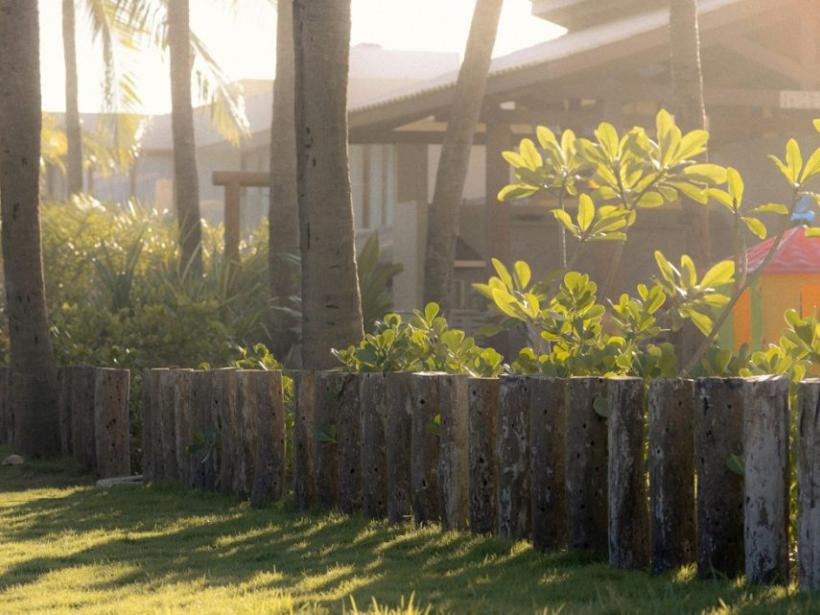
What are the best low-maintenance shrubs for a fence line?
Westringia, or coastal rosemary, is a top choice for a neat hedge that rarely asks for the secateurs. The popular variety Westringia fruticosa reaches about 1.5 metres high and wide, with soft grey-green foliage and a flush of small white flowers in spring and summer. It grows in full sun, handles wind and light frost, and needs only a light trim once a year to keep its shape.
Grevillea brings bird-attracting blooms and a natural, bushy form that suits a less formal fence line. Look for compact cultivars such as ‘Robyn Gordon’ or ‘Superb’, which stay under 1.5 metres tall and spread a similar width. They flower for most of the year in warm districts and need little more than a tip prune after the main flush to stay dense.
Lilly pilly varieties give you a dense screen of glossy green leaves and colourful new growth. Dwarf forms such as Syzygium australe ‘Tiny Trev’ or ‘Pinnacle’ grow tall but narrow, reaching two to three metres high while staying under a metre wide, so they suit a boundary without crowding the path. A light shear once or twice a year keeps the hedge tidy and encourages fresh bronze-red tips.
- Westringia fruticosa grows about 1.5 m x 1.5 m, needs full sun and one annual trim.
- Grevillea ‘Robyn Gordon’ stays under 1.5 m tall, flowers year-round and attracts native birds.
- Syzygium australe ‘Tiny Trev’ reaches two to three metres high but only 60 to 80 cm wide.
- Callistemon ‘Little John’ offers red bottlebrush flowers on a compact 1 m shrub for full sun.
- Rhagodia spinescens, or saltbush, forms a silvery 1.5 m hedge that thrives on neglect in dry inland gardens.
- Correa alba, or white correa, is a rounded 1 m shrub with grey leaves and starry white flowers in autumn and winter.
Which climbing plants suit a fence without damaging it?

Whether a climber harms your fence depends on how it grows. Twiners such as hardenbergia and star jasmine wrap their stems around a support and are safe for timber and Colorbond fences when you provide a sturdy trellis or wire grid. Tendril climbers like pandorea send out thin curling tendrils that grip lightly, causing no structural damage if guided onto a frame.
Self-clinging plants use aerial roots or adhesive pads to stick directly to a surface. They can lift paint, trap moisture against timber and leave marks on Colorbond, so avoid them on a shared or finished fence. A well-chosen climber on a separate support gives lush vertical cover without a repair bill later.
Three reliable non-invasive climbers for Australian fences are:
- Hardenbergia (native sarsaparilla) is a light twiner with purple or white winter flowers; it suits sun or light shade and does not smother a fence when pruned once a year.
- Pandorea jasminoides (bower of beauty) is a tendril climber with pink-throated white blooms from spring to autumn; its fine tendrils grip a wire or lattice without biting into fence panels.
- Star jasmine (Trachelospermum jasminoides) is a twiner with glossy evergreen leaves and fragrant white summer flowers; it grows slowly enough to stay manageable on a narrow trellis.
- Pandorea pandorana (wonga wonga vine) is a fast tendril climber that offers clusters of cream or yellow flowers; it works well on a sturdy frame beside a Colorbond fence in full sun.
- Clematis aristata (Australian clematis) is a tendril climber with starry white spring flowers; its light structure suits a wire grid in part shade without weighing down a timber fence.
What grows well along a fence in dry or coastal areas?
Plants in dry inland spots need to cope with low rainfall and hot sun, while coastal gardens add salt spray and sandy soil to the challenge. A handful of tough natives handle both conditions without constant watering once established.
Coastal rosemary (Westringia fruticosa) forms a dense, grey-green shrub that shrugs off salt wind and needs no extra water after the first summer. Pigface (Carpobrotus glaucescens) spreads as a succulent groundcover with bright pink flowers, binding sandy soil and surviving on rainfall alone. Old man saltbush (Atriplex nummularia) gives you silvery foliage that reflects heat, and you can trim it into a low hedge or leave it loose. For a softer look, fountain grass (Pennisetum setaceum) adds movement with its arching seed heads, though you should check your local council list as it is weedy in some regions.
Dig in plenty of compost before planting to give roots a head start in poor ground. Water deeply once a week for the first two months, then ease off so the plants harden up. A layer of coarse mulch keeps the root zone cool and stops salt crust forming on the surface.
- Coastal rosemary suits full sun and clips neatly into a formal hedge beside a fence.
- Pigface spreads fast over bare soil and holds sand together on sloping blocks.
- Old man saltbush handles both drought and salty bore water without burning.
- Fountain grass adds height and texture where you want a softer, less formal edge.
- Kangaroo paw (Anigozanthos flavidus) brings strappy leaves and tall flower spikes in red or yellow.
- Coastal banksia (Banksia integrifolia) grows into a small tree over time, giving shade and bird habitat.
What plants work in a narrow space beside a fence?

A strip only 300 to 500 millimetres wide can still support a lush screen if you choose plants with a naturally upright habit. Avoid anything that will push against the fence or send bulky roots sideways into footings and neighbouring paths.
Slender weavers bamboo (Bambusa textilis ‘Gracilis’) forms a tight clump no wider than 1.5 metres at maturity and its culms grow almost vertically. Nandina (Nandina domestica, especially the slim ‘Gulf Stream’ or ‘Obsession’ forms) stays under a metre wide and brings red-toned foliage in cooler months without invasive roots. Upright rosemary (Rosmarinus officinalis ‘Miss Jessopp’s Upright’) gives you culinary sprigs and small blue flowers in a column that rarely spreads beyond 600 millimetres. Kangaroo paw (Anigozanthos hybrids) sits comfortably in a 400-millimetre-wide bed, sending up tall flower stems from a low, strap-leaved base.
Space each plant so its mature width sits just clear of the fence line, usually 300 to 400 millimetres from the palings, and avoid species known for surface runners. Tuck a drip irrigation line behind the plants to keep the narrow strip watered without wetting the timber.
- Install a root barrier 400 millimetres deep if the fence is on a boundary with a neighbour’s paving.
- Choose clumping bamboos, never running types, because runners travel sideways under fences.
- Position the tallest uprights at the back and lower tufted plants like liriope at the front edge.
- Trim kangaroo paw flower stems at the base after blooming to stop the clump flopping outward.
- Mulch lightly with pea straw to hold moisture without piling it against the fence palings.
How do you prepare the soil before planting along a fence?
Start by clearing the planting strip of weeds, grass and rubble. Mark a line at least 500 mm out from the fence to give roots room and to keep foliage from pressing against the palings. Call Before You Dig Australia on 1100 before you break ground, especially if you plan to dig deeper than 300 mm near a boundary.
The strip directly under the fence misses most rain, so the soil there is often compacted and bone-dry. Dig that top 200-300 mm of soil over thoroughly with a garden fork. If the soil holds water after rain, work in coarse river sand or gypsum to improve drainage before you add anything else.
Spread a 50 mm layer of well-rotted compost or aged manure over the whole strip and fork it through the topsoil. Rake the bed level, position your plants with enough space for their mature width, then water them in well. Finish with a 75 mm layer of coarse mulch, keeping it pulled back 50 mm from the fence timber and the plant stems to prevent rot and termite pathways.
What ornamental grasses suit a fence line?

Clumping grasses are a practical choice for a fence line because they add soft texture and movement without sending out invasive runners. Lomandra, poa and dianella are three reliable native options that handle a range of Australian conditions. Most only need a hard cutback once a year to stay tidy.
- Lomandra longifolia (Spiny-head Mat-rush). A tough, evergreen clump that reaches about 1 m high and wide. It handles full sun to heavy shade and grows in most soil types, from sandy coastal ground to clay. Trim the whole clump back to 15 cm in late winter to remove old, tatty foliage.
- Lomandra 'Tanika'. A finer-leafed, compact cultivar that stays around 60 cm tall with a similar spread. It is more drought-tolerant than the straight species and rarely needs extra water once established. The soft, weeping form looks good massed along a fence in full sun or part shade.
- Poa labillardierei (Common Tussock-grass). A native grass that forms a dense, fine-textured clump up to 80 cm tall, with airy flower heads that rise a little higher in spring. It grows in full sun or light shade and copes with wet feet, which makes it useful near a fence where runoff collects. Cut it back to 10 cm in late winter before new growth starts.
- Dianella caerulea (Blue Flax-lily). A strap-leafed perennial, not a true grass, that works the same way in a planting scheme. It reaches about 50 cm high, spreads slowly by rhizomes but stays in a defined clump, and produces small blue flowers followed by purple berries. It tolerates full sun and deep shade, and you simply pull out any tired leaves by hand a couple of times a year rather than cutting the whole plant.
- Dianella revoluta (Black-anther Flax-lily). A more compact species that stays under 40 cm, with stiff, upright blue-grey leaves. It suits full sun and poor, well-drained soil, making it a good pick for dry inland gardens or coastal spots. Remove old leaves individually as they brown off to keep the clump looking fresh.
All of these grasses stay in their spot and won't damage fence footings or pop up in the neighbour's yard. A once-a-year trim or tidy-up keeps the planting looking deliberate rather than overgrown.
How do you combine plants so the fence line looks good all year?
Start with a simple layering idea. Place taller shrubs closest to the fence, then medium grasses or perennials in the middle, and low groundcovers at the front edge. Staggering plants hides bare stems and gives the border a full, natural look without crowding.
Choose plants with different flowering times so something is in bloom across every season. A typical mix for a sunny spot might include spring-flowering Grevillea, summer colour from a compact Bottlebrush, autumn-flowering Bluebeard, and a winter-flowering correa. Weave in plants with grey or burgundy foliage, such as a low artemisia or a purple cordyline, so the bed has texture even when flowers are scarce.
A sample plan for a 4-metre stretch in full sun:
- Back layer, against the fence: two Westringia 'Wynyabbie Gem' spaced 1.5 metres apart for year-round grey-green foliage and small mauve flowers.
- Middle layer: three clumps of Lomandra 'Tanika' planted between the shrubs for fine evergreen texture and small yellow flower spikes in spring.
- Front layer: a drift of Myoporum parvifolium as a dense groundcover that spills forward and produces tiny white flowers from spring to autumn.
In a partly shaded fence line, swap the Westringia for a taller Bird's Nest Fern or a clump of native ginger, and use a strappy groundcover such as Dianella instead of Myoporum. The same layering principle works, with foliage contrast doing the heavy lifting in lower light.
Frequently asked questions
Can I plant right up against a Colorbond fence?
Yes, but leave a gap of at least 30 centimetres between the plant and the fence. Colorbond reflects heat on summer afternoons, which can scorch foliage, and good airflow helps prevent fungal problems on both the plant and the fence.
How often should I water new plants along a fence?
Water deeply two to three times a week for the first six to eight weeks, then gradually stretch the interval. The strip directly under a fence tends to be drier because the fence blocks light rain, so check the soil moisture with your finger before watering.
What is the fastest-growing screening plant for a fence?
Hardenbergia and star jasmine are among the quickest climbers, often covering a fence panel within two growing seasons. For a shrub screen, lilly pilly varieties such as 'Resilience' or 'Pinnacle' grow roughly a metre a year once established.
Photo: Alef Morais, Unsplash (Unsplash License)