
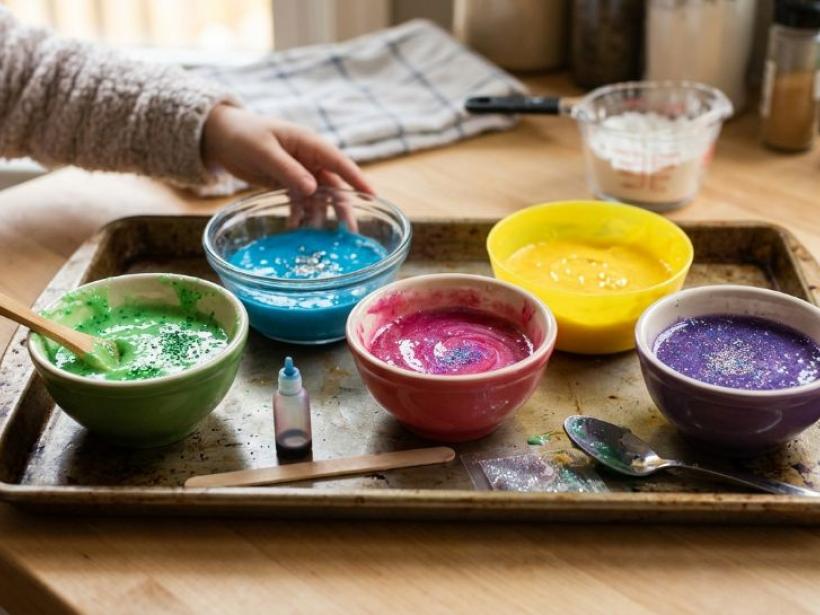

Goo is what kids call anything squishy, sticky or stretchy they can play with, from slime and oobleck to soft, smeary pastes. You can make goo at home with things you probably have already: cornflour, bicarb soda, dishwashing liquid, shampoo, psyllium husk or PVA school glue. All five recipes below skip borax powder. Four need no glue, and three need no cornflour.
Key takeaways
- Oobleck, made from cornflour and water, is the easiest place to start with young kids.
- Psyllium husk slime is the stretchiest recipe with no glue, cornflour or borax, but an adult has to do the microwave step.
- Contact lens solution slime isn't really borax-free. The solution contains boric acid and sodium borate, just less of it than borax powder (ScienceInsights).
- Glue slime, oobleck and bicarb soda goo are easy to fix if they come out wrong. Soap goo and psyllium slime are harder to rescue.
A note on measurements: several of these recipes come from US sources, which use a 15 ml tablespoon. An Australian tablespoon holds 20 ml. For the loose recipes this doesn't matter. For the glue slime, where the activator counts, use a 15 ml measure, or fill your Australian tablespoon about three-quarters full.
Quick comparison
| Recipe | Type | Main ingredients | No borax? | No glue? | No cornflour? | Sticky? |
|---|---|---|---|---|---|---|
| Oobleck | Goo | Cornflour, water | Yes | Yes | No | Messy, cleans up with warm soapy water |
| Soap goo | Sticky goo | Cornflour, dishwashing liquid | Yes | Yes | No | Yes, slippery |
| Psyllium slime | Slime | Psyllium husk, water | Yes | Yes | Yes | A little, jelly-like |
| Bicarb soda goo | Sticky goo | Bicarb soda, shampoo | Yes | Yes | Yes | Yes, creamy paste |
| Glue slime | Slime | PVA glue, bicarb soda, contact solution | No borax powder, but has boric acid | No | Yes | Sticky at first, less after kneading |
Which goo recipe should you make first?
Oobleck, for most families. It uses two ingredients, takes a couple of minutes and wipes up with warm soapy water. If the texture's off, a little more cornflour or water sorts it out.
After that, it depends on the kid (hypothetical examples):
- A three-year-old who still tests everything by mouth: oobleck or psyllium slime, since both are made from food ingredients. Stay close anyway. Coles advises that oobleck shouldn't be eaten.
- A six-year-old who wants something to squish and smear: soap goo or bicarb soda goo.
- A ten-year-old who wants the stretchy slime from YouTube: glue slime, with an adult measuring the contact solution. Elmer's says its slime projects aren't suitable for children under 3 and need adult supervision (Elmer's recipe sheet via Office Depot).
What's the difference between goo, slime and oobleck?
They're all goo, but each one holds together in a different way.
Slime is a polymer linked by an activator. In classic slime, the polymer is PVA school glue, and the activator is borax, liquid starch, eye drops or contact lens solution (Arm & Hammer). Psyllium husk slime gets its stretch from a plant fibre gel instead, which forms when you heat it with water (MudMates).
Oobleck is cornflour suspended in water. Move slowly and it flows like a liquid. Squeeze or tap it and it feels solid, which is why it's called a non-Newtonian fluid. The name comes from the 1949 Dr. Seuss book Bartholomew and the Oobleck (Craft-at-Home Family).
Sticky goo is my own name for the soft pastes in recipes 2 and 4. They don't stretch like slime. They squish, smear and cling to your fingers.
Recipe 1: How to make goo at home without glue or borax (oobleck)
Oobleck is the classic goo with no glue and no borax. Coles recommends 2 parts cornflour to 1 part water.
You need:
- 1 cup cornflour (called cornstarch in the US)
- ½ cup water
- Food colouring (optional)
Tip the cornflour into a bowl and pour the water in slowly, mixing with your hands. If it runs off your fingers like milk, it needs more cornflour. If it cracks and crumbles, add a splash of water. It's ready when it holds together as you squeeze it and drips away when you open your hand.
Coles describes oobleck as non-toxic but says it still shouldn't be eaten. Keep that in mind with toddlers.
Recipe 2: Two-ingredient soap goo
Cornflour mixed with dishwashing liquid turns into a soft, slippery goo, somewhere between dough and paste. Left Brain Craft Brain suggests starting with 1 tablespoon of dishwashing liquid and 1 teaspoon of cornflour, then experimenting from there.
Add cornflour a little at a time until it holds together, then knead it. It gets messy because soap slides everywhere, so cover the table first. Keep hands away from eyes, and wash up afterwards.
Left Brain Craft Brain does note one upside: after cleaning up the soap, the table ended up cleaner than when they started.
Recipe 3: How to make goo at home without cornflour (cornstarch): psyllium husk slime
With no cornflour, glue or borax in the house, psyllium husk makes the most slime-like goo of the five. Psyllium is a plant fibre sold as a supplement. It's the main ingredient in Metamucil, and it gels when heated with water (MudMates).
You need:
- 1 tablespoon psyllium husk powder
- 1 cup water
- Food colouring (optional)
- A microwave-safe bowl
An adult should handle this part. Stir the psyllium, water and colouring together. Microwave in short bursts and stir between each one. It foams up as it heats, so stay by the microwave. Stop once it's thick and gel-like, then leave it to cool completely before kids touch it. It firms up as it cools.
Recipes give microwave times anywhere from about 1½ to 4 minutes, because microwaves vary. Short bursts are the safer approach.
Recipe 4: How to make goo at home with bicarb soda (baking soda), no glue
Bicarb soda plus shampoo makes a creamy, spreadable goo with no glue, cornflour or borax. Arm & Hammer keeps the recipe loose:
- Pour 1 cup of bicarb soda into a bowl.
- Squeeze in about 1 tablespoon of shampoo or dishwashing liquid and stir.
- Keep adding shampoo a little at a time until it turns creamy.
- If it goes runny, stir in a pinch more bicarb soda.
The goo takes on the shampoo's colour, so a bright shampoo saves you the food colouring. Arm & Hammer says plain shampoo works best. A 2-in-1 shampoo and conditioner makes a softer, more slippery goo.
It won't stretch. This is goo for squishing and smearing, not pulling.
Recipe 5: Stretchy glue slime without borax powder
The stretchy slime kids see online needs glue and an activator. Elmer's recipe uses one 5 fl oz bottle of PVA glue (about 150 ml), ½ tablespoon of bicarb soda and 1 tablespoon of contact lens solution. These are US tablespoons (15 ml).
Pour the glue into a bowl and stir in the bicarb soda. Add the contact solution slowly and keep mixing until the slime starts to pull away from the sides. Then knead it with your hands. It feels sticky at first and less so the longer you knead.
Check the contact solution label first. It has to contain boric acid, or the slime won't form (The Best Ideas for Kids). The bicarb soda isn't the activator here. It raises the pH so the boric acid can bind the glue together (Colour Slime).
Elmer's recipe sheet says to get medical help if more than a tablespoon of contact solution is swallowed. So the bottle stays with the adult, not on the craft table.
Is "borax-free" slime really borax-free?
Not if it's made with contact lens solution. Contact solution works as an activator because it contains boric acid and sodium borate, which are chemically related to borax. It adds less boron than borax powder, so it does reduce the risk. But calling these recipes borax-free is misleading (ScienceInsights).
Recipes 1 to 4 in this roundup contain no boron compounds at all.
Sources disagree about how much to worry. Children's National says borax is generally considered non-toxic, but recommends avoiding eye contact, swallowing and long skin contact. ScienceInsights cites at least one documented case of serious chemical burns from borax slime. It calls that rare, and says milder reactions like redness and peeling are more common.
In my view, if your child has eczema, cuts or cracked skin on their hands, or still puts things in their mouth, stick with recipes 1 to 4 for now.
How do you fix goo that's too sticky or too runny?
That depends on which goo you made:
- Glue slime too sticky: add a little more contact solution, about ¼ of a US tablespoon at a time, as Elmer's recipe sheet suggests (Office Depot/Elmer's). Go slowly, because too much turns it stiff and snappy.
- Glue slime too runny: knead in a pinch of bicarb soda. If it firms up too much, work in warm water a teaspoon at a time (Arm & Hammer).
- Bicarb soda goo too runny: add a pinch more bicarb soda (Arm & Hammer).
- Oobleck too runny or too dry: add cornflour or water in small amounts (Little Bins for Little Hands).
Soap goo and psyllium slime are harder to rescue once they're too wet. In my view, starting a fresh small batch is often quicker. That's opinion, not a sourced rule.
How do you store and clean up homemade goo?
Oobleck keeps for up to 24 hours in a loosely covered container. Give it a stir before you play again (Little Bins for Little Hands). Glue slime should be stored in an airtight container. I couldn't find reliable storage times for the soap, bicarb soda or psyllium recipes, so make small batches and throw them out once they dry or smell off.
To clean up oobleck, let it dry a little, scrape it into the bin and wipe the surface with warm soapy water (Little Bins for Little Hands). The same idea works for the others: scrape up most of it first, then wash.
FAQ
What's the easiest way to make goo at home?
Oobleck. Mix about 2 parts cornflour with 1 part water. It takes a couple of minutes and needs no glue or borax.
Is goo the same as slime?
Not quite. Slime is one kind of goo, made by linking glue or another polymer with an activator. Goo is the broader word, and it covers oobleck and soft pastes too.
Can you make stretchy slime without glue?
Psyllium husk slime comes closest. It stretches and jiggles like jelly. I'd expect it to be less elastic than glue slime, though I couldn't find a source that compares them directly.
Is contact lens solution slime safe for kids?
It contains less boron than borax slime, but it still contains some. Elmer's recommends adult supervision and says it isn't suitable for children under 3.
You don't need a kit to make goo at home. Most of these recipes use things already in your pantry or bathroom cabinet, and the easiest ones take less time than finding the craft box.
Keep glue slime for older kids, with an adult holding the contact solution. And if a batch of oobleck or bicarb soda goo comes out wrong, a pinch of powder or a splash of liquid usually fixes it.
Start with oobleck today. When your kids want something stretchier, try the psyllium husk slime next.